

by Megas Alexandros (alias Fabio Bonciani)
published on THINK BRICS
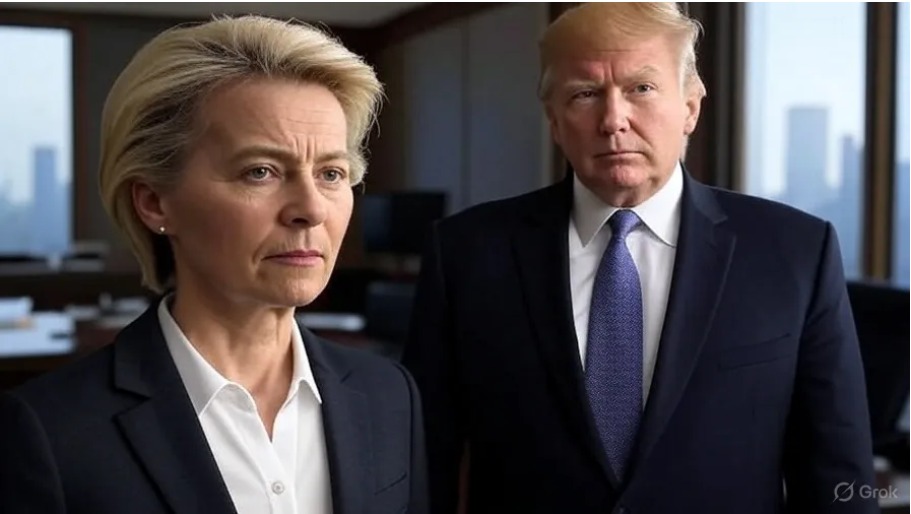
Scotland hosted the meeting between two contenders pursuing the same “demented” objective of mercantilist policy. Brussels surrenders to Trump to keep the European project and its currency afloat. As always, the American and European people will pay the price. No concerns for BRICS if their leaders know how to correctly use the monopoly over their currencies.
The EU’s Predictable Capitulation
Last week, amid the political “free-for-all” staged in Rome and Brussels regarding Trump’s imminent tariffs, I concluded my article by hypothesizing that Trump’s demented policy of taxing those who provide real goods to his people could add hope to those who have long been savoring the end of the eurozone and its currency.
Unfortunately, this will not be the case. It was quite predictable that the EU would do everything possible not to lose its monetary creation and its “damned” rules, essential tools for keeping power firmly in the hands of the elite classes that guide the European project, clearly directed toward a return to their “glorious” medieval glory days.
The Scotland Summit: Two Players, Same Game
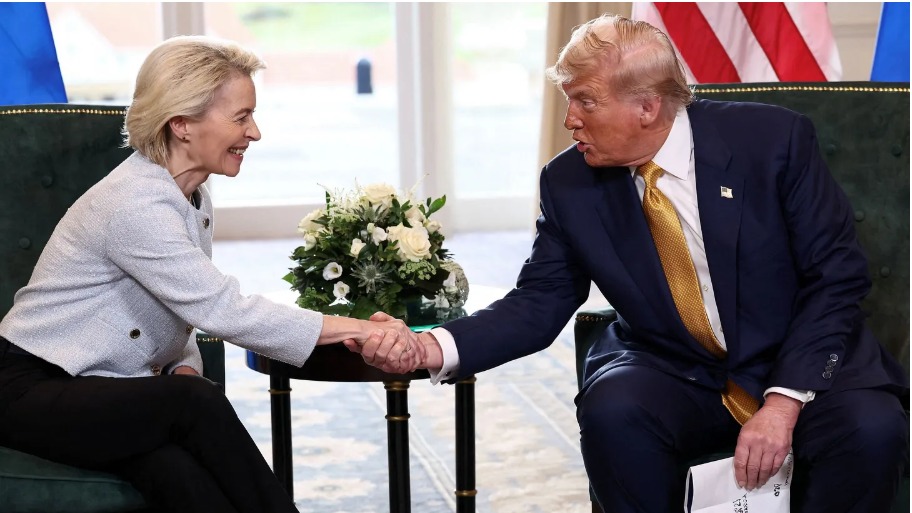
Over the past weekend, at the American tycoon’s golf resort in Turnberry, Scotland, the long-awaited meeting took place between Donald Trump and European Commission President Ursula von der Leyen, necessary for the Brussels government to try to keep the same demented mercantilist policy afloat that the Washington government now wants to make its own. Exporting more than one import has now become an indispensable “must” for the European elite’s enjoyment at the sight of people constantly living in deprivation, even of the most essential goods.
For those who still haven’t made it clear, in Scotland, facing each other were two political figures, both clashing to obtain the same “loot.” Both the sitting US President and the leaders of European countries, both on behalf of their respective lobbies, reasoning in macro terms, as far as the economic systems of countries and nations are concerned, think they win if one seizes the other’s money.
States vs. Corporations: A Fundamental Misunderstanding
By now, propaganda from the Western world has definitively equated states with private companies. And those who find themselves in government positions, once they reach the helm of their country, reason in terms of budgets and financial needs exactly the same way, as if they were managing one of their companies, rather than a State.
If for a company belonging to the private sector, seizing other people’s money is a strict necessity, for a State, it is completely superfluous, since governments produce money itself under monopoly conditions. Conversely, for a State, obtaining goods and labor to provide for itself and thus satisfy the needs of its people should be the priority.
We all know, however, that Trump and von der Leyen certainly did not meet in Scotland in the interest of their peoples, but rather in that of the elite classes that put them in command.
The Global Shift: From US Imports to Manufacturing
For some time, overseas, it has been decided that the United States should no longer be the net importer of products from the rest of the world, and consequently, Americans will have to abandon their current work commitments to return to working and producing in the factories that Trump intends to build. China and Europe must now get it out of their heads that they have exclusivity over mercantilist policy, which for decades belonged to them exclusively.
If in Beijing they have long been – with government printing presses already set to make Chinese people consume the production that Americans will no longer consume – quite happy to pass the baton, granting Trump what is a Pyrrhic victory, regarding precisely seizing the burden of working for others; in the EU, on the contrary, they have no intention of reversing the government dial positioned since its birth on austerity. Supporting domestic demand to make Europeans consume is unthinkable. For their elites, increasing numbers on account statements, representing currency produced by others, remains the priority.
And for this reason, to avoid greater damage, faced with the prospect of a failed agreement with Trump, which would have led to a dramatic escalation of tariffs and counter-tariffs and uncontrollable mutual retaliation – which would certainly have seriously endangered the European Union itself – they preferred to sign an agreement, knowing from the outset that it would be impossible to maintain it within the current budget rigor required of member countries.
Trump, in his madness, exults and celebrates the agreement, defining it as “probably the greatest deal ever reached in any field, commercial and non-commercial,” and on the other side in Europe, they are already thinking about what diabolical magic they can invent to continue having their cake and eating it too.
The Agreement’s Terms: A Pyrrhic Victory
To prevent the 30% tariffs that Trump would have imposed on most European products starting August 1st, von der Leyen accepted that average tariffs on European exports to the United States increase from the pre-Trump era’s 4.8% to 15%, involving strategic sectors such as automobiles, semiconductors, and pharmaceuticals. Furthermore, Europe also commits to purchasing $750 billion worth of American energy products over the next three years and to increasing investments in the United States by an additional $600 billion. Brussels has also agreed to open European markets “duty-free” for US goods and to purchase “large quantities” of US armaments, as emphasized by Trump.
On the delicate front of steel and aluminum, currently burdened by a 50% tariff, a quota system will be established that will progressively reduce tariffs. The agreement finally provides for US-EU cooperation to counter Chinese overcapacity, especially in the steel sector.
The Energy Paradox: An Impossible Promise
Now, just take as an example the clause of the agreement relating to the promise to import $250 billion per year in energy from the USA, to understand that von der Leyen was in Scotland only to kick the can down the road. A political move, consisting of a “promise” to postpone the issue to future discussions, and meanwhile bring home the reduction of tariffs to 15%. A vain reduction, since last February the dollar has depreciated against the euro by 15%, thus bringing the price problem for those exporting from the Old Continent to the United States back to 30%.
BRICS Opportunity: Learning from Western Mistakes
The nightmare that is about to befall European countries in the face of Washington’s change of course on international trade must serve as a lesson to those in the BRICS world who are still attracted by the dream of a common currency. Only national currencies well-utilized by local governments – following what Beijing is doing – within what is their fiscal policy function, can sterilize, to the point of nullifying them, the effect that Trump’s tariffs could have on their economies.
Indeed, to tell the whole truth, production from overseas could also be an opportunity to reallocate their workforce toward other sectors. And should there be a need for some of them to take advantage of exchange rates to strategically support some export sectors, their central banks can always operate toward dollarization, today an element of instability for Washington’s desires to rebalance the trade balance.
Returning to the energy theme and the agreement signed in Scotland, with which the EU, instead of undertaking a path toward safer energy independence, seems to have placed itself totally in the hands of the United States. This too can become a strong strategic advantage for the BRICS world, which will be able to enjoy Russian gas and oil at significantly lower prices than their European competitors.
And even if, given the data, it will be virtually impossible for European countries to respect such an agreement, nothing will be able to destroy such a strategic advantage for BRICS, graciously granted by the autopilot that is steering Europe straight toward the iceberg.
In fact, if we look at 2024, summing the value of imports of crude oil, LNG, and metallurgical coal from the United States, we would get a total of about $94 billion. A figure that, although purely indicative as it is subject to fossil price fluctuations, represents less than a third of the $250 billion that is the subject of the agreement. Von der Leyen, therefore, signed an agreement that is impossible to maintain, unless, in servitude to energy lobby profits, they are already thinking of making energy prices for families and businesses “float” so high as to reach that goal. I dare not imagine the level of social drama that would be reached in Europe, should the endless greed of those who guide us go that far.

The Economics of Self-Inflicted Damage
Overseas, the introduction of tariffs is configured as the largest and most regressive tax increases ever inflicted on American consumers. The elimination of such imports through tariffs (while the United States is close to full employment) amounts to a huge negative supply shock, similar to a failed harvest. It is a one-time, self-inflicted, and highly regressive reduction in consumption, thus in living standards, which likewise benefits the rest of the world.
Naturally, it benefits that part of the world whose governments show they understand how exchanges really work in modern economic systems, guided by fiat money, which by its nature is a public monopoly. It is clear that, faced with a Trump who wants to reverse his foreign accounting, the perfect science of “double-entry bookkeeping” requires that on the other side someone accepts the relative deficit required to consent to the White House’s surplus desires.
Europe’s Stubborn Path: Austerity Over Prosperity
While as mentioned, China seems to have well understood what weapons are at its disposal to not give a damn about the serious period of “menopause” that conditions Trump’s economic policy, in Brussels, removing the reins from government budgets to face the consequences of the just-signed agreement, supporting employment and domestic consumption, instead, doesn’t cross their minds at all.
They will try to test again the ability to bear loads without suffering permanent deformation or breakage of European peoples, with yet another show of force that elites have imposed on the majority of all of us for decades. Meanwhile, as the Italian Premier Meloni has also stated, they will act case by case, resolving on the spot the criticalities of the most affected sectors, which could jeopardize the European project.
The Italian Factor and Future Prospects
Rest assured, the Italian-led EU will not abandon austerity, and the Rome government will be on the front line fighting to complete the European federalist project dreamed of by Draghi on behalf of Italian elite families. A project that, as we know, provides for people confined in debt and perpetual renunciation even of basic necessities.
Trump will leave sooner or later, and someone else, perhaps more compliant with the European elite project, will find themselves placed in the Oval Office.
USA and EU fighting for the same demented “loot” will unequivocally advantage the growth of economies and consequent well-being in countries that make up the BRICS area, if only their leaders know how to read, at the level of economic doctrine and correct use of the monopoly over their currencies, the epochal changes underway.
by Megas Alexandros


0 commenti